

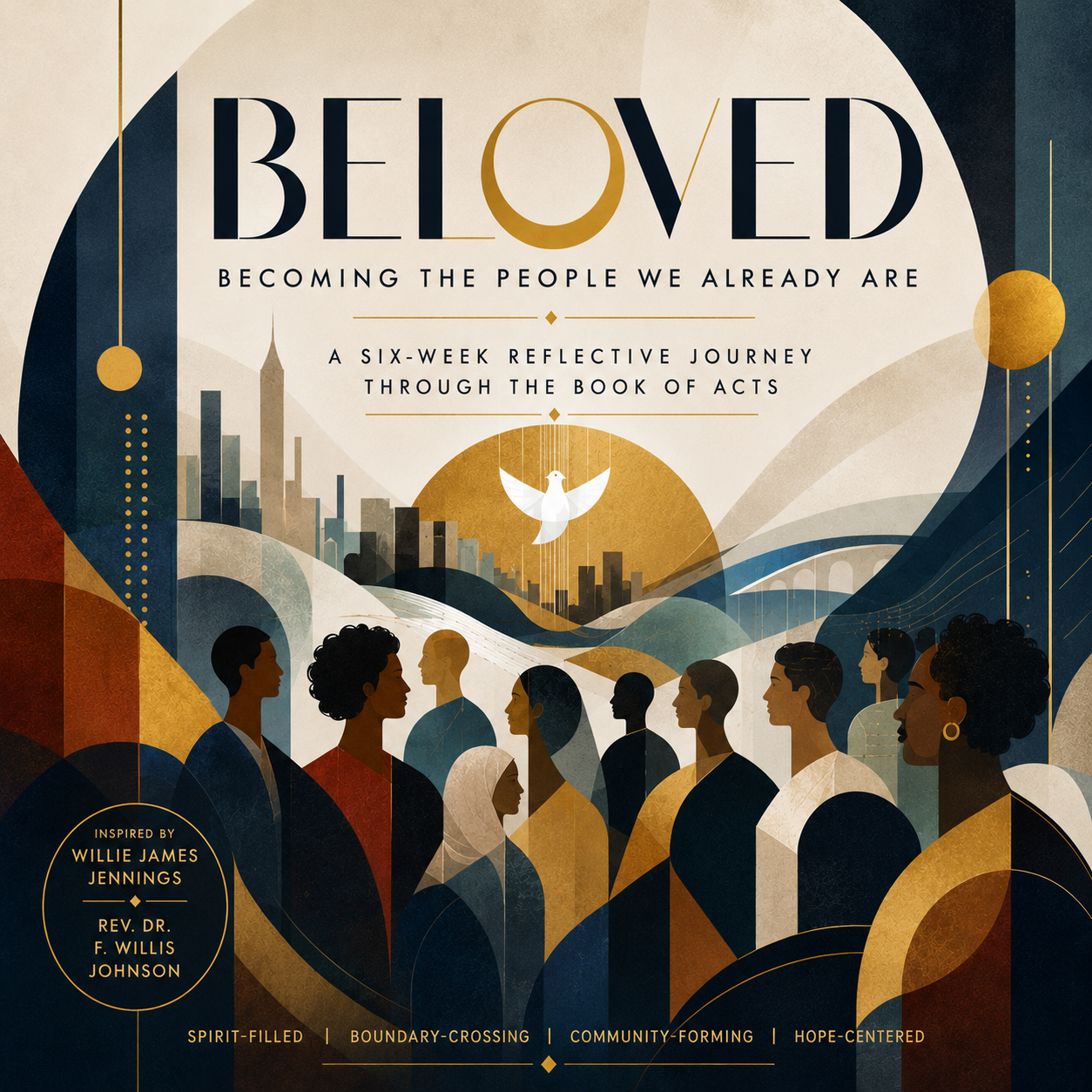
BELOVED: A Six-Week Journey through the Book of Acts
Introduction
The Book of Acts is often seen as a story of church growth, missionary work, or new ways of being the church. But behind these themes is a deeper truth: Acts tells the story of how God works to create a loving community.
The Spirit does not merely launch an institution. The Spirit forms a people. The Spirit interrupts inherited divisions. The Spirit redraws boundaries. The Spirit teaches strangers to become siblings.
In his commentary on Acts, Willie Jennings argues that Acts reveals God's refusal to allow humanity to remain trapped within the confines of fear, tribalism, possession, and exclusion. The Spirit continually gathers people into relationships they would not have chosen on their own.
This study invites participants to take active steps beyond simply learning Acts. I hope you accept the challenge to practice and embody this book's message as a beloved community. By "embody," we mean living out the values and tenets of faith in concrete ways.
The interrogatives guiding these six weeks are simple:
What if we became the beloved community God calls us to be?
How might your life and relationships look different if you truly lived out this calling?
-WEEK ONE-
"Beloved Before the Beginning"
Scripture Reading
Acts 1–2
Foundational Insights
Pentecost is not primarily about miraculous speech. Rather, the Spirit honors difference while creating belonging. The Spirit encourages unity without uniformity.
Reflection Prompt
Where have you confused Christian community with cultural similarity?
What parts of your identity have you assumed must be diminished to belong?
Weekly Prayer
Holy Spirit, help me see others as divine gifts, not projects, property, or problems. Amen!
-WEEK TWO-
"Who Gets In?"
Scripture Reading
Acts 3-4
Chapter Three
Reflection Question:
Where have we grown comfortable with situations God never intended? What kinds of exclusion have we allowed to become “normal” in our churches or communities? For example, have we overlooked patterns that leave out people because of their age, background, disability, race, or economic status? Are there invisible barriers that keep some from full belonging simply because they do not fit an unspoken norm?
Journal Prompt:
What realities have I resigned myself to—realities God might want me to challenge?
Reflection Prompt:
When you hear “salvation,” what do you picture? Personal forgiveness? Heaven? Moral improvement? How might Acts stretch your understanding?
In what ways do your current views of salvation align with or differ from what Acts presents here?
-
Greetings. I'm Reverend Dr. F. Willis Johnson, and welcome to Beloved,
a guided discipleship experience that journeys through the book of Acts. Together,
we'll discover how the Holy Spirit forms strangers into family, transforms fear into courage,
and calls ordinary people to extraordinary witness. Drawing from the biblical narrative of Acts and
inspired by the theological insights, of Professor Dr. Willie James Jennings.
I believe this study invites our exploration into what beloved community looks like,
even in a divided world. And whether you're new to scripture or a lifelong student of faith,
it's my prayer that you come ready to listen, to reflect, wrestle, and grow.
Because Acts isn't just a story of early church. It's our story of becoming the people we already
are.
So in this edition, we are
Discovering who gets in as we read chapters three and four of Acts.
I believe when people discuss Acts, one of the common questions is how did the church grow?
But I believe the real question goes deeper than that. It's a question of who is allowed to belong.
In his reflections and study of Acts, Willie Jennings observes God breaking our habits of excluding
one another.
He believes that the spirit pushes us past old boundaries towards authentic acts and ways of
belonging.
That is why I want to bring front and center to your attention a few things.
Beginning in chapter three, in its opening verses, there's a man placed at a gate who exhibits for
us the very geography or typography of exclusion.
I think it's interesting that Luke puts the man in his story, not in the temple,
but not entirely outside of it either.
There's a unique positioning when we find this man at the gate.
Gate signal transitions. Who gets in? Who stays out?
And yet this man, this one unnamed, lives between always what is visible,
in being visible, yet excluded.
And his exclusion is normalized.
I think it is important as you study this text, I want to invite you to think and reflect on this
interrogative. Where have we grown comfortable with situations that
God never intended for us? Where have we grown comfortable with situations,
circumstances, maybe even places in our lives? that God never intended for us to find comfort.
Moreover, what kinds of forms of exclusion have we allowed to become normal in our own lives,
but in our church or even in our community?
When I think about this, I think of how we have overlooked patterns that leave out people because
of their age, their background, their abilities or limitations.
that thereof, ways that we have allowed the patterns of race and economic status to
exclude or to divide us. And I struggle, even in my own faith and everyday practice,
to recognize the invisible barriers that somehow,
in many ways, keep others from fully belonging, most
because they just
Our unspoken norms or expectations.
But also in this text, there is healing and restoration. As you continue to read chapter 3,
verses 11 through 26, there's a focus sometimes on the miracle.
But I think within the miracle is always a meaning. And Luke highlights this.
Peter centers the healing and... notes the restoration that is promised and possible when one is in
relationship with and through it in ways like Jesus Christ.
In Acts chapter 3, in these verses, Luke offers up healing and the opportunity for us to understand
that healing is more than physical. It means full participation,
full accessibility.
And for Jennings, true healing actually is restorative in body and in spirit and in relationship.
Acts shows also salvation as a means and form of participation.
And that is one of the pillars of restored or restorative justice and community.
And salvation is not just some kind of personal forgiveness.
Salvation changes the life of us all, and it invites us into a life together.
I hope as you study chapter three of Acts, that you will look for new insights,
that you will wrestle and raise questions that maybe you've not considered before,
and that you will find others to be in conversation and dialogue with. Comparing your
understandings and your respective pictures or new imaginings and possibilities and perspectives on
what it might mean to be both
salvific as well as welcoming.
In Acts chapter 4,
there's an interesting thing happening. The authorities of that day felt threatened.
upset about the miracle itself. Their real concern is how this phenomenon of new meaning,
new imagining, new ways of becoming and how the social order may bring into question their own
authority. Matter of fact, they raised this by asking the question about what power or name were
the disciples, the apostles, able to do what they did in the verses that preceded.
I think it's interesting when you read chapter four that the acts that are offered,
they're contrasting in nature. One is about preserving the status quo versus creating something
new. And the established authorities of the text fear that this radical and restorative inclusion,
again, disrupts, disturbs the social order. Because much of social standing,
order, hierarchy, culture of that day,
and yet in our day, is exclusion-based. Most systems.
are organized on not who is included, but how and who is excluded.
I think this is also an interesting observation that Dr. Jennings raises in his own scholarship,
where he talks about acts shows the spirit changing who belongs, changing the perception and even
the precedent for who belongs, and inviting and modeling the remaking,
the reshaping of relationships through stirring and strong acts of resistance that are carried out
in this newfound movement and community.
I think one question to consider as you study deeply this chapter is why or
where?
Where is it that you and I are being invited or compelled or pushed towards greater acts of
justice,
greater exercises and efforts of inclusivity?
Courageous acts of reconciliation or even healing in our own lives, church or community.
I don't know about you, but there's a lot there to be discovered in the early verses and through
the whole chapter of Acts.
But ultimately, I believe Luke shows the spirit that
is met and received in the preceding chapters of our study.
It's still yet not only transcendent, but transformative.
And much of it is changing fear into courage and inviting away a life or discipleship that is
faithful that then becomes or continues to be fruitful.
Take time to explore and consider some of the prompts for thought.
and
imagining. Take some inventory and allow yourself to be met in the mirror of the world where you
can see not only who you are, but who you are and how you and I ought to be. But in closing,
I hope and believe that
you will find or at least consider your
articulation to this question.
Are you and I building gates? Or are we opening entryways and making paths for others to come,
to connect, to belong?
Are we part of the establishment? Or are we part of this new aspirational and radical and
imaginative and exciting and inviting movement?
A
community that wants as many for the sake of all, to the glory of one.
I believe the Holy Spirit grows, enlarges, expands,
makes extensive, empowers immensely.
And by the Spirit we find and can be bound and binded together in family,
in community, encircled, marked by divine healing and
love of God.
I hope as you study in
this iteration,
of our offerings of work and reflection that you identify at least one practical way you can help,
again, open the gate for someone else or invite them more deeply and intimately or further into
what is the innermost parts of a circle of relationship or connectivity and commonality.
Whether by inviting someone or breaking down a barrier or offering a genuine expression,
sign, and act of welcome.
That's the minimum, the basic thing we're called to do as people who are struggling and striving to
find our way in relationship with God through Jesus Christ.
Moreover, I hope by the time you finish, you will be able to have and have germinated or created
some new ideas. Some new imagining, some new possibilities, some new forms of witness that you not
only employ in your life, but you could bring to bear in the community, in the gathering, in the
larger lection that is known as the study of beloved.
Thanks for making time. I hope you will fall in love with this word and that you will know that as
you read this word, you are loved and called to be loved in the world.
So go make it happen. And until we meet again.
Be encouraged.
-WEEK THREE-
"Integrity, Interruption, and the Table: Becoming Beloved Community"
Scripture Reading
Acts 5-6
Listening to the Margins: The Spirit often speaks through those the world ignores. Who are the “widows” among us today? What does it mean to truly listen, and then act?
Shared Power: Beloved community means shared responsibility. Leadership isn’t about status, but service. Who are we inviting to the table? Who gets to decide, to lead, to shape the future?
Public Witness: Our life together is a testimony. When we live with integrity, when we care for the vulnerable, when we share power and resources, the world sees a glimpse of God’s dream.
Reflection Prompt:
Where is God inviting you to deeper honesty—in your relationships, your giving, your service? Who are the people at the margins of your community? How might you listen to their needs and empower their gifts? What step could you or your church take this week to make the table bigger—sharing power, resources, or responsibility? How can your life together become a visible sign of God’s beloved community in the world?
Study Notes
Acts 5:1-11—Integrity is the foundation of beloved community. Trust is hard-won, easily lost, and always worth protecting.
Acts 5:12-42—Bold witness flows from shared trust and a Spirit-led courage.
Acts 6:1-7—Beloved community grows when we turn toward those on the margins and share power across lines of difference.
-WEEK FIVE-
Scripture Reading
Acts 9-10
Acts 9 Prompts:
Who are the “Sauls” in our world—those we fear, those we cannot imagine loving?
What would it mean for us to be Ananias, stepping into rooms we’d rather avoid, trusting that God’s work is bigger than our boundaries?
Acts 10 Prompts:
Where do we resist the Spirit’s push toward togetherness?
Who are the Corneliuses in our lives, in our churches, in our neighborhoods?
-
Grace and peace, friends, and welcome back to Beloved, a reflective study on the book of Acts.
I'm Reverend Dr. F. Willis Johnson. And in this session, we continue our journey through the living texts, exploring Acts chapters five and six. And we do so together, drawing from the deep well of wisdom from Dr. Willie James Jennings, as we seek to discern what it means to be God's beloved community.
I invite you to take a couple of deep breaths and ready your thoughts. Focus your mind, whether you're in your car or at a kitchen table on a walk or even listening with others. I invite you to open your heart to God's word and hope that you are diving deeply into God's word, reading these chapters along with us throughout this week.
If you don't mind, I'd love to give you a little bit of an overview of both chapters five and six.
First, Acts chapter five. And if I was to subtitle this, I talk about the emphasis on integrity and trust that is required for beloved community. See, Acts five opens with a story and it's a story that's hard to kind of shake from.
Ananias and Sapphira, this couple tried to hold back. Part of their gift while pretending to have given all that they had. And when confronted, both found themselves in dire situation and the punishment of their sins was death.
Now, on the surface, it's a story about money and consequences. But moreover, this is about something much deeper. It's about the soul of community.
Dr. Jennings. Suggests that beloved community is built on trust, not perfection, not appearances, but real risky and honest confidence and commitment, even covenant one with another. The spirit is forming a people who can be vulnerable with each other and with God, yet trusting enough that love will always abound. However, when trust is broken. The community suffers. And when we pretend and when we hide and when we build walls where God wants windows and doors, then community suffers.
In the beloved community, the Spirit of God calls us, each of us, into the practice of integrity and the discipline of such as well. Not just in what we say, but in who we are. When no one is watching or with us, as well as who we are when we're together. We are invited to bring our whole selves, our real selves to God and to each other.
And I understand that's challenging and that's not always easy or even. But but it's also required and it is an expression of being liberated or free. What might look like what it might look like to be part of a people. Where you can be honest about your weaknesses. What might it look like if we could be the kind of people who could truly express our needs or or share what our real struggles are? I believe when we are able to do that, to be that kind of vulnerable and open and truthful and real in our relationships, one with another and know that we'll still be loved. That's a powerful thing. That's a beautiful thing. It's a welcome thing, particularly in a world where it's hard to be your actual self, where it's hard to tell the truth about yourself. And in a world where in a time where everything is a facade or has veneer. Acts chapter five also shows us the power of public witness.
See, the apostles in this text keep healing, keep proclaiming, even amid being. Under threat is one point in that where they say we must obey God rather than any human authority. If that ain't revolutionary, I don't know what is a reminder that from this text and much of this, this book is that beloved community is not a private or hidden thing. It's bold. It's visible. It's unashamed. It's a people who live their convictions. Even when the world. Resists them or even wants to cease for them to exist.
Next, there's Acts chapter six. And this is about the margins and the extending and the expanding of what I believe to be the proverbial table.
And in Acts chapter six, the church or this community formed in faith faces a challenge, not from the outside, but from within. Some of the widows, this is the Greek speaking women on the margins are being neglected. This community, like any beloved community, struggles and oftentimes is tempted to overlook some and to center the familiar while forgetting the different. But the spirit won't let this slide in the text. No. The apostles call everyone together and invite this faithful community, the church, to choose leaders from among the neglected. I think it's interesting that Dr. Jennings calls calls this the spirit led reordering, a spirit led reordering.
The community of faith listens to the pain at the edge of their circle and responds not with defensiveness, but with acts. And strategies of empowerment. They don't just fix the problem. They create space and elevate new voices and trust the spirit of the Lord to work through them and with them.
I want you also to to make light and notice that the work of waiting tables.
What is the weight work of waiting tables? Well, that's the feeding, the caring, the organizing is not a lesser calling to serve. is the calling of us all. Matter of fact, before people were called pastors, or what's inherent in the term of pastor or minister, is actually from the root of servant. To minister is to serve. To be a minister is to be a servant. Enlisted in the service of God to the servant. The work of service and waiting tables is holy. It's the heartbeat of any community, but particularly a beloved community. If the pulpit is where we proclaim the gospel, ladies and gentlemen, then the table is where we practice it. Both matter. Both are sacred work.
You find Stephen and this harsh encounter in reality. Stephen is one of the seven, one of the one of those who are called out to be deacons or to be servants and reminds us that leadership in God's community is born out of and where the need is greatest. Now, we could say a whole lot about Stephen. And when you read the text, there's a lot that has to be unpacked. And I hope you will come back with your questions or inquiries of sorts and share them with me. And even in your dialogue and your continual study that you may wrestle with some of the harder dimensions of what is offered up in Acts chapter six.
Nevertheless, the spirit raises up leadership and servants, raise up those who have been overlooked to become agents and representatives. And we're in and mold and means for healing and justice in their very community.
So if I had to give you a cliff note version and highlight what are the areas of teaching and of applied practice towards becoming a beloved community, it would be these four things. Hope you got a pen and paper. Take copious notes here because the first one is honesty and trust. Beloved community can't grow where people are hiding. where people can't be vulnerable, where people can't be honest with themselves and each other. We need the courage to be authentic one with another, to welcome the truth, our respective truths from one another, even when they present to be uncomfortable.
But honesty and trust is required, a required practice. To shape and to form and to sustain beloved community. The next is listening to the margins. The spirit often speaks through those the world and sometimes even we internally ignore. Who are the widows and the children among us today?
What does it mean to truly listen and to act on not only their needs, but to act in love? Because love is responsive to not only the needs, the wants and the desires, but but love wants more for others. Love wants more for others than even we want for ourselves. And so listening to the margins, listening to those that are often not always asked or heard is paramount in practice of shaping, nurturing, growing beloved community. Next is shared power. Beloved community means shared responsibility. Leadership isn't about status. But service, you just don't get a title. You've given a title because you have some responsibility and some accountability. There's some expectation and there's some dedication that's required to be a leader. It just don't make you special. It doesn't just give you opportunity to tell somebody else what to do. No, no, no. Matter of fact, it deputizes and requires of you and I to be the kind of people who are in constant acts and availability of service. Who are we inviting to the table and how are we waiting on the table? Who gets to decide to lead and to shape the future is also part of being a leader, because in our leadership and in the sharing of power, we find ways for everyone to find a way to be, to be a part of. To be in be part of be invested in as well as be an investment and invest in what we're doing to share in what is the gift and the graces and the promise of God in our life. After honesty and trust, listening to the margins, shared power. Lastly, there's public witness. We are not called to come to church to stay in the four walls of the church.
Community that is beloved, that is loved of God and wish to express that love of God. means that we have to have a life, that we do life together, and that that life that we do together becomes a testimony. When we live with integrity and when we care for the vulnerable and when we share power and resources, the world sees a glimpse of God and God's kingdom in action on earth as it is in heaven. And the public witness that we have is one that witnesses or evidences God in our own lives and God in our collective work.
When we call ourselves a community of faith or church, we have a public witness that we must honor and we must engage in. And so you cannot go in drag or in hiding at work or in play or outside in all of your social network and other network experiences and act as if you don't know God and that God is not in you. Matter of fact, part of being enlisted in the service in relationship with God is that we find ourselves in constant witness and worship publicly. Our lives and our lifestyle is our worship. How we live, not just on Sunday, but Monday through Saturday is the evidence of how authentic and how faithful we are in our faith.
I hope that this is helpful to orientating you towards what it means to begin to develop and be strengthened in community. There are some questions of reflection or prompts to help to further guide and encourage your own thinking and even your own assessment of of where there are places to grow and to go and how God may be speaking and focusing you in these days ahead.
But I also want to just leave you with this, beloved. The book of Acts, particularly in these chapters, shows us that the spirit won't accept business as usual. God is continuously calling us into authentic or honest and earnest, courageous care and shared responsibility. God is a God of equity. So everybody has a part to play and everybody's part is important. Everyone's been bespoke or given a gift that is unique to them. And as a space and opportunity and community, particularly community formed in faith, needs to be made so that people can express that and share in that.
Beloved community isn't just a theme or slogan. It's a practice. It's a way of living, of loving and making space for God's people, all of God's people. And my hope is that we become a people at Christ Church or in whatever settings that you find yourself in company and in connection. who listen deeply and who share what we have and who open and avail our table and every circle to every heart and to everyone.
I pray that you will make time to sit with these questions, that you will pray this week. That you'll talk not only with God, but you'll talk with others to be encouraged and to find inspiration. And then that you will not just talk about it, but you'll be about it. That you will literally do as the text, the acts of the apostles, that you will act. And as you act and as you do so, I pray that you will trust that the spirit is still making and molding and melding us individually and collectively into who God wants us to be. And I believe that's a beloved community.
So until next time. Keep reading. Keep wrestling. And keep the faith.
Be encouraged. Most of all, know that you're loved and you're called to go be loved in the world today.
Until we meet again. Blessings.
-
Greetings. I'm Rev. Dr. F. Willis Johnson, and this is Beloved. Welcome back.
Whether you're joining me on your morning walk, driving to work, or sitting on your porch with a cup of java, or simply carrying out a quiet moment in your day, I want to thank you for making room for God's word and for this conversation. Beloved is our guided journey through the Book of Acts, where we are together discovering how this book and its peoples simply aren't a story about first century Christians. No, it's the continuing story of what God does whenever ordinary people allow the Holy Spirit to shape them into an extraordinary community.
In a previous episode, we talked about Peter and John and how they met a man sitting outside the beautiful gates, and we talked about how community has been imagined and reformed and invited into new responsibility one with another. We talked about how the power of the Holy Spirit lives and is endowed and empowers each of us. Today, I want to take our story to another level.
In this particular study of the Book of Acts, we find the church about to experience its first great crisis. Yet, as we discover this and experience this with them, God has a remarkable way of bringing new life from moments that look like endings. Will you pray with me? Gracious and loving God, open our hearts and minds to your word.
As we listen to the stories and read the stories of Stephen and Philip and the Ethiopian traveler, remind us that your love is always wider than our imagination. Continuously give us courage to follow whenever your spirit leads and when the path is unfamiliar. We pray this prayer in Christ's name.
In chapter 7, I believe it's a story worth remembering. It's a story where a man named Stephen is highlighted. Stephen isn't one of the twelve disciples.
He isn't famous. He's simply someone who has allowed God's spirit to shape his life. He's an ordinary individual who, with and through God, and the power of God through him, does some extraordinary things.
However, he's brought before a religious leadership council. And Stephen wasn't able to defend fully his actions, his way of being to them. But he does tell this story.
And I want you to know it's not just his story, it's the story of God. He begins to profess the word of God. Beginning with Abraham, moving through Joseph and Moses, Stephen reminds the crowd that God has never been confined to one place, one building, or one people.
Again and again, God has met people on the move. God has met people where they're at. God has invited people to go sometimes where they never imagined they would go.
God has met people in deserts and foreign lands and in unexpected places. And Stephen wants to admonish or impress upon those who are listening to remember something that they had forgotten. That God is always bigger than their or our expectations.
I don't know about you, but sometimes I know I make the mistake of believing that God only works in certain ways and in certain places. Maybe you begin to believe that God only works inside of a certain church building at a certain location. Or only through a certain type of people or group of people.
Or only in a manner in which that is comfortable for you and yours. Your for and no more. But Acts keeps reminding us that the Holy Spirit has a habit of surprising us.
God is always moving ahead of us, inviting us to catch up. So this is something I invite you to take note on. God cannot be contained.
Yet God can always and is willing to be encountered. You can't contain God. God's too high, you can't get over Him.
God's too wide, you can't get around Him. God's too low, you can't get under Him. I don't know if you've got a peafunk theology or not.
But understand that God cannot be boxed in. God cannot be contained and yet God is always willing, wanting, available to be encountered. So what new encounters are you willing to enjoy with God? I'm excited about how Stephen speaks up for the truth.
How Stephen speaks out of his trust in God. And sometimes that may, just may, anger some people. It did in Stephen's case.
It angered a crowd. So much so that they decided to kill him. That's right.
They decided to stone him to death. It's one of the hardest moments in the New Testament. Yet even in this heartbreaking scene, Stephen looks remarkably like the ultimate ethical exemplar in Jesus.
Stephen, like Jesus, forgives. Stephen, like Jesus, prays in the midst of his persecution and death. Stephen entrusts himself into the care of God.
I've come to realize that faithfulness doesn't always protect us from hardship. Sometimes our very faithfulness requires that we go through such. I believe there's one theologian who writes that the measure of discipleship isn't just simply what we believe about Jesus.
It's how much our lives begin to resemble Jesus's life. Wow, that's powerful. That's worth sitting with.
Sitting with the notion of not just do I believe in Jesus, but am I becoming more like Jesus? Am I willing to go and to endure like Jesus? I don't know all the places where God's inviting you to choose faithfulness over your convenience. I don't know where you might be struggling to be and experience kindness amidst criticism. I'm not sure how much forgiveness you're willing to yield to the more powerful emotion and want to remain resentful.
But these are all the questions and the examples for contemporary believers that I think Stephen invokes through his witness. I think it's interesting that after Stephen's death, of course, fear would spread throughout the land. I mean, people literally left Jerusalem.
Families scattered. The ministry of this new way of being looks to be a failure. And a people, a scattered people again becomes scattered.
The diaspora again and again. It finds itself in many places. The believers who were scattered, however, preached the good news wherever they went.
And in a season that has found ourselves celebrating things like Juneteenth and our national independence, out of many we are one. Out of one we are many. And yet, wherever we go, we take that with us.
We take one another with us and we take, in our case as faithful disciples, the good news. It's interesting that the very thing meant to stop the gospel in the stoning and in the crucifying, in the demeaning of the faith and in individuals of faith, is the very thing that helped it to spread. And sometimes life feels that way.
Sometimes the very job, the very relationship change or the diagnoses that arise seem like our plans and our lives are falling apart. And we might even think that God has abandoned us. But Acts reminds us, in this chapter and many more, that God often does God's best work in seasons when we never have chosen.
Chosen what we are experiencing, what we are enduring, what we are faced with. I'm glad the church didn't stop being the church because it's scattered. Maybe you've experienced this kind of sense of things falling apart and scattering in your life.
Maybe one of the hardest seasons of your life became the very place where your faith grew its deepest, its most resilient. I hope that chapter 7 of Acts reminds you or even encourages you in such a time. When you continue to read, we find an unexpected conversation in Acts chapter 8. It introduces us to Philip.
Philip is traveling down a lonely road when the Holy Spirit nudges him towards a chariot. And inside that chariot is an Ethiopian official reading the scroll from the prophet of Isaiah. This curious, searching, excited new believer is still yet seeking understanding.
And so he invites a tutor. Philip begins to share with him. He begins with a question asking, do you understand what you're reading? It's interesting that, of course, kind of haplessly and helplessly, I'm sure the Ethiopian official acknowledges, no, I don't.
I really don't. But more importantly, he says, how can I unless someone guides me? Someone teaches me. I love that exchange because it is both professor and pupil or mentee and mentor.
And as I've told my children growing up, that you have a right to demand to learn and to grow. And your teachers have a responsibility or those who know better have a responsibility to do better or help us to do better. And so in this instance, we see the opportunity or formula for discipleship.
So Philip teaches him. And I want you to know that that's why we have discipleship like Bible study and conversations in small groups, because no one is expected to figure any of this thing called life or faith out alone. And I believe that faith is grown, nurtured, supported in conversation and reflection.
And I'm so glad that Philip listens as well as shares. And together they discover the scripture points to Jesus. This is one of the more poignant questions in the entire book of Acts, I believe, or situations in the entire book of Acts, because the Ethiopian then sees water and asks, what is it to what will prevent me from becoming baptized? Is there any reason I don't belong? Is there any reason why I can't be part of what you now have made clear to me I ought to be a part of? I love the answer.
It's no. Nothing. Nothing prevents God's love.
Nothing. Nothing prevents God's grace. Nothing prevents God's eternal welcoming from any one.
The gospel, by default in design, is meant to expand the circle whosoever, all who believe. And every time we think we've reached its edge, when we thought we've had whoever and everyone already, there are more. There's a wider net to cast.
There's a larger and wider circle to draw. There is always room for more in God's kingdom. So what does Acts 7 and 8 ask of us? I believe it's three simple things.
First, remember God's story. When in life feels uncertain, don't fear. Become the loudest voice you can hear.
Remember where God has been faithful. Remember your story and God's story. Second, I believe that no matter what, no matter what and where, trust God.
Trust God, and even in the moments and in the sense of scattering or the times where things are falling apart, that that's an opportunity for God. And instead of asking, why is this happening? Maybe you and I ought to ask, what new thing might God be doing, growing, expecting in our lives? And then third, I don't know about you, but walk towards opportunity. Walk towards the chariot.
Walk towards and take full the invitation. Pay attention to the things and to the places and to the people that God has allowed your past to encounter. There just might be someone, groups of someone or some opportunity there waiting for you.
Not with all the answers, but for simply your willingness and your wantedness to sojourn with them. I hope this has been helpful to you. And I hope you're equally excited about what God's word is encouraging and challenging us to do and become.
I want to leave you with this prayer for us together, and I hope you pray this prayer throughout your study. God of every journey, thank you for meeting us on familiar roads and unfamiliar ones. When life feels scattered, remind us that your spirit is never scattered.
And when we are uncertain, remind us that your love is steady. Give us the courage of Stephen. Give us the attentiveness of Philip.
Give us the spirit and curiosity of the Ethiopian. That we may be open to love and grace and newness of life. More importantly, as faithful ones of you, let us be people who are looking for, who are noticing, people who are listening, people who are welcoming in the world today.
And above all, may we be people who reflect the love of you. Through Jesus Christ. This we pray.
Amen. Hope this was helpful and hopeful. Until next time, beloved.
Remember that the Holy Spirit is always at work ahead of you. Keep your eyes on the prize. Recognize Christ is in unexpected places and people and things.
But moreover, I pray you have the courage to walk towards and get into some good trouble and some deep conversations, not only with God, but on behalf of God. Be encouraged, my friends.
-
Greetings, I'm Reverend Dr. F. Willis-Johnson, and welcome back to Beloved, our virtual Bible study, a journey through the book of Acts. This week, we're stepping into two of the most disruptive, beautiful, and theologically rich chapters in the book of Acts. And as been our custom, we draw from the very deep well of insightful offerings and from one Willie James Jennings, whose commentary on Acts invites readers to see these stories not just as ancient events, but as ongoing calls to conversation and conversion, the change or the transformation of self, of community, and of the very boundaries we draw around God's love. Let me set the stage for you, because in the book of Acts, we are experiencing a fractured world. Not just a movement is being afoot, but a particular kind of movement of people, not just going from city to city, but the movement of God's spirit. Transcending boundaries no one could ever expect. And sometimes these boundaries are the kind that no one ever thought we could ever cross.
But Dr. Jennings writes that X is the story of God drawing near to the world, to flesh, to difference. And it's about God refusing to be contained by cultural, ethnic, or religious barriers. So there's two distinct stories in both chapter nine and 10, uh, Saul's conversion. And then the encounter of Peter and Cornelius. And, and both these stories, I, uh, are about crossing over about crossing over and about God's relentless insistence that the circle of love or the circle that becomes the beloved is always bigger than we imagine let's start with Acts chapter 9 you may or may not know Saul but for those who have studied the Bible you know this Biblical character as one who is a persecutor. A zealot. And most notably, the one who watched approvingly as Stephen was killed. But in this text, God's spirit interrupts Saul's certainty on the road to Damascus. The light blinds him, but it also opens him up. And scholarship notes that this is not just a personal transformation, but a communal or seismic change.
I'm particularly interested on how Dr. Jennings looks at Saul's conversion, understanding it's not a solo act. Matter of fact, there are others that participate. It requires Ananias, a disciple who is terrified of Saul, yet who listens to God and goes to him as led. And Ananias is asked to embrace his enemy or the one who threatens, presents a threat as his brother. God's making a new world where enemies become family and fear gives way to embrace. I think it's interesting that Saul's transformation is incomplete or maybe not even fully realized without God. The obedience of another in Ananias and the hospitality of another also represented in Ananias. I think we are reminded that conversion has social implications, not just personal ones. God doesn't just change Saul or us, but in and through us and through Saul, he changes community. Therefore, the beloved community is enlarged every time a boundary is crossed and love abounds. Next, there's Acts chapter 10, where Peter and Cornelius are brought together.
If Saul's story is about the conversion of the persecuted, then Acts 10 is about the conversion of the insider, because Cornelius, a Roman centurion, receives a vision, and so does Peter's. a faithful one. For Peter, the vision is unsettling though. What God has made clean, you must not call profane. This message is clear. God is not interested in our categories of particularity, clean and unclean, insider, outsider, seasoned saint or newbie. I think there's a masterful description that's offered up on Acts chapter 10. as a moment that the church must learn to desire togetherness. God orchestrates a meeting that neither Peter nor Cornelius would or could have planned. The spirit falls on Gentiles and Peter is left stunned, forced to admit that God shows no partiality and that God is a God of all. I want you to understand this is not just about Ritualizing of food laws. No. No, this is deeper. This is a deeper discomfort of being changed. By encounters with those we often considered othered.
The embrace of Cornelius. The inclusion of Gentiles. Forever changes Peter's perspective. Maybe that's the church's mission. To be changed and to change. I do believe that the church's mission is not to bring God just to the Gentiles. But to recognize God is already at work in them prior to their offering or to their summoning or to their invitation. Maybe that's the confusion that missionaries had some time ago as they made their way to the mother continent. Assuming that. The many people there were polytheistic that they had many guys because they named God in everything and everywhere and in every way. No, same God. But God shows up and shows out and is evident and alive and well and present. And we acknowledge the presence of God and the power of God in ways that are contextual or relevant or specific to the very nature or expression or offering of God. There's an Ashanti proverb that says no one has to show a child the sky. Maybe you don't have to show or tell somebody who God is, but invite them to for themselves name and claim and realize and recognize.
And and also you and I accept that God is already ahead in the not yet of us while we're in the where while we're in our and where we are in our business. God is already in the not yet in the here and now we are here. But God is already in the not yet. And God is already working and transforming. I agree with Jennings that we're all being converted all the time. Our conversion is just that. That suffix of I-O-N is a process. It's a continuum. That also speaks to how God interacts with us in terms of inviting us to not only do better, but be better and become better. That's why we are not perfect, but we are being perfected. The Christian life, the disciples life is, is one of a series of conversions of heart, of mind, of practice. And the Spirit is always at work unsettling us, drawing us into deeper communion. So as we reflect on Acts 9 and 10 and the scholarship of Brother Jennings that invites us to see beloved community is not a static group. It is not a collection of like-minded people, but it is a living, breathing body, always being stretched out always being expanded, always being improved by the power of the Spirit.
And each and every conversion story is a story about the expansion and the expression of love, the crossing of or the erasing of our self-imposed boundaries. As you read these texts this week, I pray that you will take away maybe some of these notable points One, God's love is always moving outward and God's love may just cause us to be disturbed in our and drawn out of our own comfort zones. Remember that conversion is communal. That transformation of God enacts in and through us is is unlikely to. Also can occur in people who we perceive to be unlikely, worthy or expected. Also, the spirit is calling us. Calling us into radical togetherness across lines of indifference. And difference. And lastly, our calling is to be open to the new thing that God is desirous and directing us to do in the new ways in which God is inviting us to become. even when it unsettles us. So explore this week in a practical way. Explore where God is calling you to cross a boundary. Maybe consider who God is inviting you to see as not the other, but as a beloved one.
And ask yourself, am I willing to let the spirit disrupt my comfort for the sake of a bigger and more beautiful community? My prayer is that we become people like Ananias and Peter who say yes to God's invitations, even when they scare that. Well, when they scare us. The beloved community is always one step past where we're comfortable. Yet always where the spirit is leading. I think that's enough to get you started this week. In our next session, we'll see what happens as the spirit keeps moving. The beloved community into even stranger and more holier. Acts of communion and community. Until then, I invite you to stay curious, stay open and remember. You are beloved. Be encouraged, my friend.
-
Welcome back to Beloved, our virtual space for wrestling with scripture and finding its meaning for us right now in a world that rarely fits into any kind of neat category or box.
I'm Reverend Dr. F. Willis Johnson, and it's my pleasure to journey with you through the book of Acts. We're rediscovering that Acts isn't just an ancient story. It's an ongoing work of the Holy Spirit calling us beyond our respective comforts, be across the various Boundaries and borders that we've established into a community shaped by hope and courage through faith.
In our time together in this moment, I want to look at chapters 11 and 12. And these two chapters at first glance don't seem like they belong together. In one, the church welcomes outsiders. In the other, the church faces violence and loss. One is about generosity and unity. The other about power, persecution, politics.
But Luke seems to weave them together on purpose. And I believe inherent in the question is what happens when the kingdom of God collides with the kingdoms of this world? And I don't think there's any greater and more relevant question for now than that.
But first, let's let's pray. God of every nation and neighbor. Open our minds to your word. Open our hearts to your spirit. Open our lives to your mission. That we might not just be observers, but participants in your beloved community. It's in Jesus Christ's name we pray and believe. Amen.
As you've been journeying and studying along with us, you'll realize by the time we get to Acts 11, the gospel has already crossed the Rubicon. It's crossed lines that cannot be uncrossed. Peter's entered into the house of Cornelius and Gentiles have received the Holy Spirit. And as a result, old boundaries about who belongs or who can belong to God are erased.
For generations, Israel understood itself as God's chosen people. But now God isn't abandoning the covenant. No. On the contrary, God is expanding it. The Spirit moves ahead of the church's own debt, debates, and doubts. Peter returns to Jerusalem and is immediately criticized, not for what God has done, but for how it has come about.
You went into the house of an uncircumcised man, some would question. It leaves us wondering and troubled by the fact that the focus is more so on tradition than transformation. Peter then tells the story, what he saw and what God did, and he speaks down the criticism and instead invites focus to be on worship.
So God has granted even Gentiles repentance that leads to life. And that ought to be good news for any and everybody. I believe the church's job is not to authorize God's work, but to recognize it. Whenever faith becomes more about protecting our boundaries than extending God's grace. You and I, we have lost sight of Jesus. And that kind of left me with this question as I've personally revisited this text.
Are we prepared to see God at work in people and in places who don't look like us, think like us, or live like us?There's a new kind of church afoot in Acts because after Stephen's death, believers scatter. And at first they share the gospel only with Jews, but then some unnamed believers start speaking to Greeks. Their names are lost to history, but their courage in faith changes everything. It's in Antioch, a city more diverse and cosmopolitan than Jerusalem, where the church becomes multicultural, multiethnic and visible. This is where the word Christian first appears, not as a badge of honor, but almost. As an insult, those little Christ, those, those, those, them over there. Yet the world notices not their doctrine, but takes notice of their way of life, their way of being, their living life and living love out loud.
The Holy Spirit specializes in pulling people who might not commonly share a meal, let alone a mission together. The beloved community is. in my understanding, is not really about uniformity. It's about reconciled difference and diversity. And in reconciling and rediscovering and respecting, we draw people together by the means and by the love of Christ. And as a result, we cross or crisscross the respective divides or boundaries, and we find ourselves not as strangers, but closer and more like neighbors or friends and eventually maybe even family.
In the text, there's a reference to a cat by the name of Barnabas. He's a leader known for in his encouragement. He's traveled extensively to recruit. And he is one of the healthy leaders that helps to multiply the influence of the faith. And the church in Antioch grows because its leaders are willing to bring in new voices and gifts.
Two, becomes the mark of the Holy Spirit's work. When a famine is predicted, the church doesn't hesitate. They send relief. Jew and Gentile, again, crisscrossing, erasing the lines that once divided them. I believe theology becomes action in this offering. And as I said earlier, strangers are no longer such. They now are part of the family, the larger community.
But I think it's important to understand that Acts doesn't sugarcoat reality. Now, we make our way to chapter 12. The story turns a little bit darker. King Herod cracks down. James is executed. Peter is jailed. Political power tries to crush this emergent movement of new community. And yet even under that threat, the church acts. It prays, literally. They don't. necessarily possibly panic or or just simply protest no no no they pray and prayer is not passive prayer is a sign and exercise a weapon of resistance and it's in the conversations we have with God or prayer that we find alignment with God in the face even of our fears there's this miraculous escape that that that Peter experiences that echoes the sounds and the reality or result of the Exodus story. God still liberates, is liberative. God still opens closed doors, even when hope seems all lost. But the story is realistic. It's realistic of a praying church, a praying church. can barely believe their own prayers have been answered. They did something, they wanted for something, they believed in something, and yet they were still astonished or surprised and amazed when that happened.
I think that should remind us, encourage us, and affirm many of us that faith doesn't always eliminate our doubt. No, no. Faith is not being or being absolute or absolved of doubt. No, faith is the courage to keep waiting. In the face of that very uncertainty on God to be certain.
King Herod court applause and grabs at power. Yeah, that's what he wanted. That's what he needed. But in the end, his reign collapses. Luke's quiet but powerful verdict. But the word of God continue to spread and flourish. Reminds us that empires will rise and fall. That the political winds of the day will shift. But the word of God will endure.
Man, these chapters are awesome. And they ask of us questions like, will we welcome those like God welcomes all? Can our churches become places of truly open table and not closed ranks? Will generosity and prayer define our discipleship or will worry and panic? carry the weight of our faith each day? Are we willing to trust that God's mission is always bigger, more riskier, wilder than our own plans? These are just a few of the questions that I ponder. And maybe there's many more that you will discover in your own study. But I invite you to just do that. To study, to question, to pray, and to examine.
Your understanding of the faith through the lens and the offering of the chapters 11 and 12 of Acts. Moreover, I want to thank you. Thank you for joining for yet another episode of Beloved.
My prayer is that you step even more boldly into God's expanding family. That you will be even more convinced and committed to being prayerful in and with hope. And that you will give with courage. And remember this, you are beloved. Now go and live like it. Until next time, be encouraged.
-
Hi, I'm Reverend Dr. F. Willis Johnson, and welcome.
Beloved is a six-week guided discipleship experience through the Book of Acts. Together,
we'll discover how the Holy Spirit forms strangers into family, transforms fear into courage,
and calls ordinary people to extraordinary witness. Drawing from the biblical narrative of Acts and
inspired by the theological insights of Professor Willie, James Jennings.
This study invites our exploration into what beloved community looks like in a divided world.
Whether you're new to scripture study or a lifelong student in faith, we invite you to come ready
to listen, reflect, wrestle, and grow.
Because Acts isn't just the story of the early church. It's our story,
a story of becoming the people we already are.
Let's get started. The book of Acts is often seen as, again,
a story just simply about church growth, missionary work, or new ways of being together.
But behind these themes are deeper truths. And this particular one stands out prominently.
It is that... tells a story of how God works to create a loving community,
not just any community, a loving community. And the spirit, the Holy Spirit of God,
does not merely launch an institution. No, this spirit of God forms a people,
a collective. This particular spirit that is of God interrupts the inherited divisions that the
world and society presents. The Holy Spirit of God redraws, or better yet,
gets rid of the boundaries and teaches strangers to not only become citizens,
but siblings. In his commentary on Acts, Dr. Jennings argues that Acts reveals God's refusal to
allow humanity to remain trapped within the confines of fear, tribalism,
possession, and exclusion.
Gathers people into relationship that would not only have them chose that particularly in
relationships that they themselves may not have chosen readily. This study invites participants to
take active steps beyond simply learning about this important biblical offering.
No, it is in the hopes that. You and I accept the challenge to practice or embody what is truly the
message of not only this book, but of the kingdom teachings. That is to become a beloved community,
a loving community.
Moreover, when we talk about embody, what we really mean is living out the values and tenets of our
faith and concrete and tangible and everyday situations and circumstances of our lives.
So I hope you will allow these two particular interrogatives to guide your study over this next six
weeks. The first is this question. What if we became the beloved community God calls us to be?
What if we became truly who God not only desires us to be, but has purposed us to be one with
another? The second, how might your life and relationships look different?
If you truly lived out this calling of beloved community, you may not have the answer right this
moment, but in the days and weeks to come, I hope you will grow closer to formulating and
articulating and activating in your own life of faith and living the answers to these and so many
other questions.
So in
week one, let me invite you to read the scriptures. particularly chapters one and two.
And may I offer this to think about as you begin to study not only those two chapters,
but also as you consider the reflection prompt for this week,
and as you, as often as you can, pray the prayer that is presented for this week.
But I'll start with this.
How does a movement truly begin.
Most people imagine leaders drawing up five-year plans around a table, mission statements,
visions for expansion, or some sort of blueprint for the startup or the upstart of whatever is the
new church or the nonprofit, typically. But that's not how the church is
started in Acts. Now, Acts begins quite differently, folks. It flips our ideas about beginnings.
Instead of action, there is waiting. Instead of confident planning and well-executed ideation,
there's a small group caught between hope and doubt, between Jesus's promise and what they can't
see, that stirs this new movement.
These first disciples, man, their record is not perfect.
You got Peter, for instance, the one who Jesus called the rock. who also is known for denying the
Lord when things got hard. Of course, you got, you know, Doubting Thomas.
And then the others who ran away under the pressure that they encountered.
If this were a business, it might be the time for the founder to find a new team.
But Jesus does the opposite. He stays with them. He doesn't. pick new people.
Instead, he asked them to wait together for something beyond their own strength,
to wait on the gift of the Spirit. So when Pentecost finally comes,
it's not because the disciples deserved it, though they should have expected it. It's not a reward
for fixing their mistakes or part of their consolation for confessing how they have fallen short of
the glory of God. No, it is pure grace. It is the gift and the Grace of God.
God's presence that is given to a group still full of questions, still full of flaws,
still carrying regret.
And here's what's most surprising. God's spirit, the Holy Spirit, doesn't just make everyone the
same. No, the miracle of Pentecost isn't sameness. The people in the story of the Perethean.
Medes, the Egyptians, and others, they don't lose their language or their identity or their history
as they find themselves in the collective or in the communion of this moment called Pentecost.
The Holy Spirit doesn't erase who they are. Instead, the Holy Spirit helps them to learn how to
love what is shared from another and how to take what they have.
that may be unique to them and share it with another. Not just in Pentecost,
but in the days that follow in their coming together, in their being and forming new community.
Each person in Pentecost hears the message in their own language. Their stories are honored and
they themselves are included by the power of the Holy Spirit. And something from that also then
invokes them to want to be in company and in care with each other.
It's one of the beautiful things about Methodism. Not only are we in a company one with another, we
are expected and ought be accountable one to another.
The real work and wonder at the heart of Acts is the miracle is not that everyone becomes the same,
but that they are seen and known in their uniqueness,
in the beauty of their difference. In the possibility and the promise of their bespoke nature that
is graced and given by God, they are received and acknowledged and embraced just as they are.
And being part of this new community doesn't mean giving up who you are, but always knowing whose
you are, which means you belong. You belong even when everything about you,
us, is different. We share something and someone, some power. Some purpose,
some agency, some God, the same.
So maybe the first lesson of discipleship in Acts is this. You don't start out by trying to become
someone else or hiding your own flaws or shortcomings.
Becoming a faithful follower and... disciple of God and being in the company of others who are
striving and struggling in that same way starts out by realizing that God chooses to work through
regular imperfect people. God wants to take you and I are ordinary and do extraordinary things.
And maybe God does God's best work in people and through people who have once failed or doubted or
even ran away. And the good news is that the same spirit of God comes to all of us.
Despite no matter how far, how low, how broken, how unsure,
how unaware, how unprepared, how unequipped,
unfamiliar, we may be not only with God, but with each other. The church's start isn't about strong
backgrounds or perfect faith. Now, now this movement of a foot that that that follows and becomes
in the book of Acts is about a people. who learn to love and who allow themselves to be loved by
one another and who meet each other right where they are, in their need,
in their condition with unconditional love. So as you and I reflect on this, I hope you will take
the step this week to
welcome both your own imperfections as well as celebrate the diversity of those.
who you come in contact with, who live around you, who you congregate, who you engage and intersect
with this week. Allow yourself to be part of a story,
a story that is shared, a story where you and I and we are the subject matter of God's glory.
A world that invites courageously our belonging and our willingness to love and to meet and to
greet and to experience and to share with those and in places and ways that are much other to
ourselves.
Knowing and doing so because we are loved and expected to be loved in the world. And that helps us
to begin the work and the movement afoot of the beloved community.
Now, like I said, go read for yourself chapters one and two this week. Wrestle with the questions
that have been presented and pray the prayer that God will help you and I by the power of the Holy
Spirit to see and to receive and to engage and embrace others that we come in contact with every
day as gifts,
as gifts, not as something, anything other than a gift and a child and the image and the evidence
of God alive and well in these times. And I believe if you do so.
you'll be not only beautifully and wonderfully and amazingly surprised,
you just might have an angelic encounter when you see someone anew or even the stranger and realize
they're related to you and the God who loves you.
Be encouraged.
-WEEK TWO continued-
"Who Gets In?"
Scripture Reading
Acts 3-4
Chapter Four
Reflection Prompt:
Where do I experience resistance when I advocate for justice, inclusion, reconciliation, or healing?
Reflection Prompt:
What fear keeps me from speaking, acting, or living faithfully? What would courage look like for me this week?
Notes for Your Journal
1. The Spirit helps us notice the overlooked. Acts 3 begins with attention, not action. Discipleship starts with seeing.
2. Salvation is about belonging. Healing restores community. The question remains: Who’s left outside?
3. Courage grows with the Spirit. Peter’s boldness comes from the Spirit, not self. Faithfulness precedes certainty.
-WEEK FOUR-
Scripture Reading
Acts 7-8
Rather than rushing to answers, live with these questions.
Pen your response somewhere visible. Pray them slowly or discuss them with someone you trust.
1. Where has my life been "scattered" in ways I still struggle to understand? How might God have been present there?
2. What assumptions do I still hold about who belongs in God's beloved community? Where did those assumptions originate? For example, in scripture, culture, family? Fear?
3. Where might the Spirit already be working beyond the boundaries of my imagination? What would it require for me to follow?
4. Who has been Philip in my own life? Who mentored me when I was searching for understanding in faith? Who helps me recognize Christ? Have I thanked them?
5. Whose chariot am I being invited to approach? Who is quietly asking questions no one has taken time to hear?
-WEEK SIX-
Scripture Reading
Acts 11-12
REFLECTION QUESTIONS:
Where do you see boundaries—spoken or unspoken—in your life, church, or community? How might God be inviting you to cross them?
When have you witnessed God at work in someone unexpected? What changed for you?
How does prayer function in times of fear or uncertainty for you? Are there places where you struggle to believe your prayers can be answered?
What does courageous generosity look like for you?